Masjid al-Haram, also called the Sacred Mosque or the Grand Mosque, is the mosque in Mecca, Saudi Arabia, that surrounds the Kaaba, the cube-shaped structure toward which Muslims worldwide direct their prayers. It is widely described as the largest mosque on earth, the site where Umrah and Hajj rituals take place, and the home of the Black Stone, the Zamzam Well, and the Maqam Ibrahim. For Muslims planning a pilgrimage from the US, it is the destination everything else in the trip is built around.
On a single day during Hajj season, crowds inside and around Masjid al-Haram have been reported to run into the millions. That is more people than live in Houston, gathered around one building, at one time, for one purpose.
For you, planning a trip to Mecca, that scale can be hard to picture until you are standing in it. You already know Masjid al-Haram is where Umrah and Hajj happen. What is harder to grasp from a brochure is what the mosque actually is, how it grew to the size it is now, and what you will be looking at when you walk through its gates for the first time.
This guide walks through Masjid al-Haram from the ground up: its history, the sacred structures inside it, how large it has become through more than a thousand years of expansion, and what a US traveler should expect when stepping inside for Umrah or Hajj.
Masjid al-Haram is the mosque that physically surrounds and contains the Kaaba, which makes it the focal point of Islamic worship worldwide.
Its name translates roughly to “the Sacred Mosque” or “the Sanctuary Mosque,” and in English it is most often called the Grand Mosque of Mecca or simply the Holy Mosque. It sits in Mecca, Saudi Arabia, near coordinates 21°25’21″N 39°49’34″E, at the center of a sanctuary zone where certain acts, such as hunting or uprooting plants, are traditionally restricted.
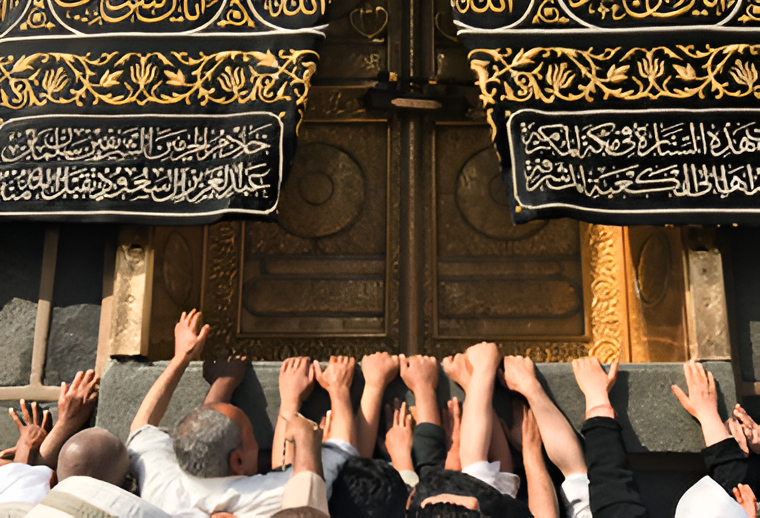
At the literal and symbolic center of the mosque stands the Kaaba, a cube-shaped stone structure draped in a black and gold cloth called the Kiswah. Muslims everywhere, whether they are praying in Jakarta, Istanbul, or Detroit, face toward the Kaaba. That direction is called the qibla, and Masjid al-Haram is the one place on earth where you do not face toward it. You face it directly, often from only a few meters away.
Masjid al-Haram is not simply a large building with the Kaaba inside it. It is the architectural frame Islam has built, rebuilt, and expanded around a single point of devotion for roughly fourteen centuries, and that history is part of what makes standing inside it feel different from any other mosque you will ever visit.
According to Islamic tradition, the Kaaba at the heart of Masjid al-Haram was built by the Prophets Ibrahim (Abraham) and Ismail (Ishmael), which is why Islamic teaching regards it as the first house of worship ever raised to God.
The Quran describes Ibrahim and Ismail raising the foundations of the Kaaba and praying that their devotion be accepted (Quran 2:127). Centuries later, by the time of the Prophet Muhammad’s birth, the Kaaba had reportedly become a shrine surrounded by idols. Islamic teaching holds that this was corrected in 630 CE, when Muhammad returned to Mecca, entered the sanctuary, and removed the idols from around the Kaaba.
That moment, known as the Conquest of Mecca, is often treated as the point where Masjid al-Haram became the mosque it is today rather than a regional shrine. Formal historical dating places its establishment as a structured mosque at around 638 CE, just a few years later
What followed was not one construction project but a relay of expansions stretching across more than thirteen centuries. A few of the turning points:
That list is not something to memorize. It is the pattern that matters: every generation that controlled Mecca found the mosque too small for the number of people who wanted to pray there, and every generation rebuilt around the same fixed point. The Kaaba has not moved. Almost everything around it has been rebuilt at least once.
Four structures inside Masjid al-Haram carry specific religious significance beyond the building itself: the Kaaba, the Black Stone, the Maqam Ibrahim, and the Zamzam Well.
It helps to know what you are looking at before you arrive, because each of these plays a distinct role in the rituals you will perform.
This is the cube-shaped structure at the center of the mosque, standing, according to Islamic tradition, on the same site where Ibrahim and Ismail raised their original structure. It is roughly the size of a small house, and during Tawaf, the ritual of walking around it seven times, it will be the fixed point your entire route circles.
Set into the Kaaba’s eastern corner, the Black Stone is described in Islamic tradition as the only surviving piece of the structure’s original construction. What you will actually see is several dark fragments held together inside a silver frame, the result of damage and repair across many centuries. Pilgrims try to touch or kiss it during Tawaf if they can safely reach it, though doing so is not a requirement of the ritual itself.
A short distance from the Kaaba sits a small enclosed stone, traditionally identified as the very stone Ibrahim stood on while building the Kaaba’s upper walls, and said to bear the impression of his feet. After completing Tawaf, it is customary to pray two units of prayer near this spot, the same place tradition holds the Prophet Muhammad prayed after his own circuits.
About 20 meters east of the Kaaba lies the Zamzam Well, linked in Islamic tradition to the story of Hajar and her infant son Ismail, whose search for water is said to have caused the spring to appear beneath his feet. Today the well still supplies water that pilgrims drink and carry home, often in sealed bottles distributed throughout the mosque complex.
This is not a random scattering of landmarks. It is a connected sequence: you circle the Kaaba, you may reach for the Black Stone as you pass it, you pray near the Maqam Ibrahim once your circuits are done, and you drink from Zamzam as part of completing the visit. Knowing that order before you go means you are not trying to work it out for the first time in the middle of a crowd of thousands.
Masjid al-Haram is widely described as the largest mosque in the world, though the exact figures you will see for its size and capacity depend heavily on which expansion phase, and which counting method, the source is using.
Wikipedia’s profile of the mosque lists its current built area at around 356,000 square meters, or about 88 acres, with a stated capacity of roughly 3 million worshippers. That alone would make it larger than many small towns.
But that figure sits inside a much bigger picture. The King Abdullah Expansion, launched in 2011 and inaugurated by King Salman in 2015, added a further 456,000 square meters of coverage on its own, more than the size of the historic mosque it was built around. Saudi state media coverage of what is often called the Third Saudi Expansion describes a project that, taken as a whole, lifts the mosque’s combined capacity toward roughly 1.85 million worshippers across the main building, courtyards, bridges, and service areas, with hourly Umrah-season throughput said to have roughly doubled, from about 44,000 to 118,000 people per hour.
Here’s the thing: none of these numbers are wrong. They are measuring different things. A figure for “the historic core” looks small next to a figure for “the entire expanded complex,” and both look small next to the crowd that physically packs into and around the mosque during the days of Hajj, when several million people can be present at once. When you read a headline number for Masjid al-Haram’s size or capacity, it is worth asking which of those three things it is actually counting.
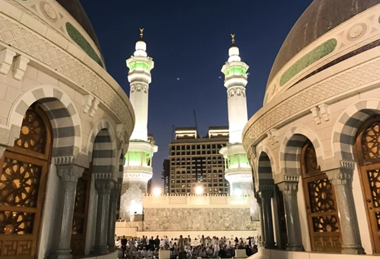
What is not in dispute is the direction of travel. The mosque now has 13 minarets reaching about 139 meters, or roughly 456 feet, into the sky, and Saudi authorities have continued expansion work well beyond the 2015 inauguration. If you visit Mecca again in five years, the mosque will likely look at least somewhat different from how it looks today. That is not a planning failure. It is what a fourteen-century-long construction project still looks like while it is underway.
Inside Masjid al-Haram, your time will center on two rituals that take place at fixed points in the mosque: Tawaf around the Kaaba, and Sa’i between the hills of Safa and Marwah.
If you are coming for Umrah, this is where the rituals you have read about become physical. Tawaf means walking around the Kaaba seven times, typically counter-clockwise, ideally starting and ending near the corner where the Black Stone sits. Sa’i means walking, or in practice today moving along an air-conditioned indoor corridor, between the two small hills of Safa and Marwah seven times, retracing the steps tradition assigns to Hajar’s search for water.
Both rituals sound straightforward on paper. Inside the mosque, you will be doing them inside a moving crowd that can range from a few hundred people on a quiet weekday morning to hundreds of thousands during the final ten days of Ramadan or the days surrounding Hajj. That density is not a side detail. It shapes how long each ritual takes, how much physical space you have, and how tired you are likely to feel by the end.
The mosque has adapted to this over time. Multi-level, climate-controlled additions to the Mataf, the open area immediately surrounding the Kaaba where Tawaf takes place, let more people circle at once without everyone being pressed into the same ground-floor ring. Elevated walkways and bridges move pilgrims between zones without funneling everyone through the same chokepoints. None of that erases the crowding. It manages it, which is a different thing, and it is part of why timing your visit, something a US-based operator can help you plan around, makes a measurable difference to how the experience feels.
As a Muslim traveling from the US, the practical side of visiting Masjid al-Haram comes down to three things: timing your trip around the calendar, understanding the mosque’s access rules, and pacing yourself once you are inside.
Timing matters because the mosque is not equally crowded year-round. Ramadan and the weeks around Hajj typically draw the largest numbers, often by a wide margin, while other months of the Islamic calendar tend to be calmer. If a more spacious Tawaf and shorter waits at the Zamzam stations matter to you, an off-peak Umrah trip will often feel very different from a Ramadan visit, even though the rituals themselves stay the same.
Access is also worth understanding before you go. Masjid al-Haram, and the city of Mecca itself, is restricted to Muslims, a rule enforced at checkpoints on the roads into the city and one that differs from the access rules at most mosques elsewhere in the world. If you are traveling with non-Muslim family members, this is something to plan around well before departure, not something to discover at a checkpoint.
Pacing yourself is the part first-time visitors most often underestimate. Between the flight from the US, the time difference, the heat, and the physical demands of Tawaf and Sa’i, it is common to arrive at the mosque more drained than expected. Building rest into your schedule, rather than trying to complete every ritual and every extra visit on day one, tends to be the difference between a trip you remember clearly and one that passes in an exhausted blur. This is exactly the kind of pacing a US-based agency that has routed pilgrims through Mecca before can help you build into your itinerary from the start.
Masjid al-Haram has spent fourteen centuries being rebuilt around the same fixed point, expanding again and again to hold more people without ever moving the place they came to see. That pattern is worth carrying into your own visit: the building changes, the crowd size changes, even the route you walk through the Mataf may change between trips, but the reason you are there does not. Understanding the mosque before you arrive will not make the crowd smaller. It will make you one of the people in it who knows exactly where they are standing, and why.
How to perform Umrah step by step
Umrah benefits and spirituality

Tell us your city, travel dates, and budget. We’ll send you a tailored package in under 24 hours.
No. The Kaaba is the cube-shaped structure at the center; Masjid al-Haram is the much larger mosque complex that surrounds and contains it, along with the Black Stone, the Maqam Ibrahim, and the Zamzam Well.
Access to Masjid al-Haram and the city of Mecca is restricted to Muslims. This is enforced at road checkpoints into the city and is a different policy from the access rules at most mosques in the US or elsewhere.
The figure depends on which expansion phase is being measured. Wikipedia lists the current built area at roughly 356,000 square meters with a stated capacity around 3 million, while figures tied to the Third Saudi Expansion describe a combined capacity closer to 1.85 million across the full complex, before factoring in the much larger crowds that gather during Hajj season.
The Kaaba, the Black Stone set into its eastern corner, the Maqam Ibrahim, and the Zamzam Well are the four most significant structures, and each one is tied to a specific part of the Umrah and Hajj rituals.
Crowds are typically smallest outside Ramadan and the weeks surrounding Hajj. If a quieter Tawaf is a priority for you, planning your Umrah trip around those peak periods is typically the single biggest factor in how spacious your visit feels.
Talk to our team today — no commitment, just honest guidance. We’ll match you to a package that fits your city, budget, and travel dates.