Hajj is one of the Five Pillars of Islam and is obligatory once in a lifetime for every Muslim who is physically and financially able to make the journey, while Umrah carries deep spiritual reward without that same universal requirement. Hajj happens on fixed dates in the Islamic month of Dhul Hijjah and includes rituals at Mina, Arafat, and Muzdalifah that Umrah does not include. Umrah can typically be completed in a few hours and performed during almost any time of year. For travelers booking from the US, that difference shows up directly in price: Umrah packages typically run somewhere between $1,200 and $3,400, while Hajj packages from the US often start around $5,000 and can run past $17,000 depending on accommodation and group size.
If you’ve started looking into a religious trip to Saudi Arabia, you’ve probably noticed that “Hajj” and “Umrah” get used almost interchangeably in travel listings and casual conversation. They are not the same trip, and treating them as if they were can lead to real planning mistakes: applying for the wrong visa type, choosing dates that don’t line up with what you actually want to do, or budgeting for a few hundred dollars when the trip you’re actually describing costs several thousand.
This guide walks through what separates the two: how each is classified in Islamic law, what you actually do during each one, when they happen, what they cost from the US, and how to think about which one to plan for first if you haven’t done either yet.
The single biggest difference between Hajj and Umrah is status: Hajj is fard (obligatory), while Umrah’s status depends on which school of Islamic law you follow. Hajj is the fifth of the Five Pillars of Islam, which means every Muslim who has istita’ah, the combination of physical health and financial capacity to make the trip without going into debt or neglecting their dependents, is required to perform it at least once in their lifetime.
Umrah sits in a different place. According to the Hanafi school, when a companion directly asked the Prophet whether Umrah was obligatory, the Prophet replied “No, it is not, but it is better if you perform it”, and the Hanafi and Maliki schools treat that as the basis for classifying Umrah as a sunnah mu’akkadah, an emphasized recommended practice rather than a strict requirement. The Shafi’i and Hanbali schools read the evidence differently and lean toward Umrah being obligatory once in a lifetime too, on its own separate basis from Hajj.
Umrah is not a smaller, optional version of Hajj that you complete on the way to something bigger. It is its own act of worship, with its own rulings, and for two of the four major schools, its own standalone obligation, regardless of where someone stands on Hajj. In practice, this means that if you can only realistically commit to one trip in a given year, the obligation that all four schools agree on, Hajj, is generally the one worth prioritizing once you’re able.
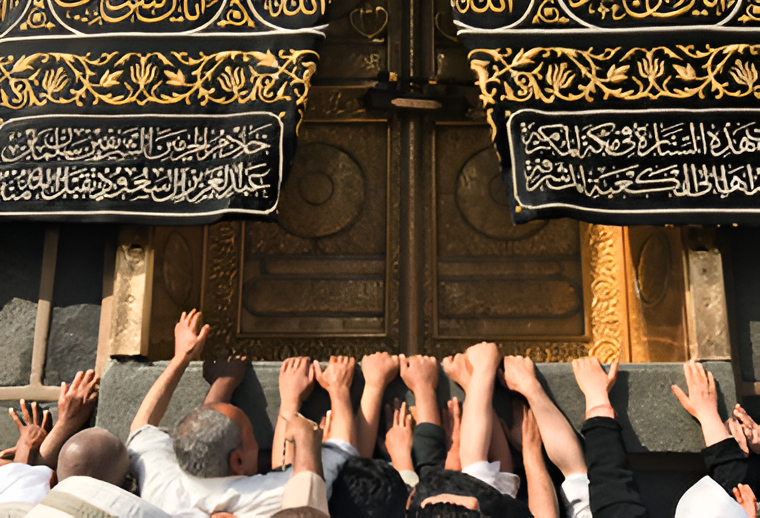
Both pilgrimages share two core rituals, Tawaf and Sa’i, but Hajj adds several days of additional rituals that a standalone Umrah does not include at all. For Umrah, you enter Ihram (a state of ritual purity marked by specific clothing and intentions, simple white unstitched garments for men and modest, loose-fitting clothing for women), perform Tawaf (walking seven circuits around the Kaaba), complete Sa’i (walking seven times between the hills of Safa and Marwah), and finish by trimming or shaving your hair. That sequence can usually be completed in a few hours.
Hajj includes everything above, plus a series of additional stages spread across five to six days: standing at Arafat, a plain outside Mecca regarded as the spiritual peak of the entire pilgrimage, an overnight stay at Muzdalifah, days spent at Mina, and the symbolic stoning of the Jamarat, three pillars representing the rejection of temptation. Most pilgrims also arrange an animal sacrifice (Qurbani) during this period, with the meat distributed to those in need.
This is part of why Hajj typically demands a level of physical preparation that Umrah does not require to the same degree. You’re often walking long distances in heat, sleeping in tents at Mina for multiple nights, and moving between sites alongside roughly two million other pilgrims in the same window. Umrah, by contrast, can often be scheduled around quieter periods specifically to avoid that scale of crowd.
The biggest adjustment for first-time travelers usually isn’t religious, it’s logistical: jet lag, unfamiliar crowd sizes, and just how much the experience changes depending on the time of year. Having helped travelers from across the US plan both types of trips, one of the most common surprises with Umrah is how different two trips can feel: a quiet weekday during a low season can mean an almost empty area around the Kaaba for Tawaf, while the final ten days of Ramadan can mean waiting well over an hour just to get close to the Haram.
For Hajj, the adjustment is bigger. You’re not only managing crowds at the Haram, you’re managing them at every stage, Mina, Arafat, Muzdalifah, and back again, often while walking long distances in temperatures that can climb past 100°F (about 38°C) depending on where Dhul Hijjah falls in a given year. Packing for heat, mobility, and several consecutive nights away from a hotel room is a different kind of preparation than packing for a trip centered mainly around one hotel near the Haram.
None of this should discourage either trip; both are entirely manageable with the right preparation. But it does mean a Hajj packing list, footwear that can handle miles of walking, lightweight Ihram-compatible layers, a plan for staying hydrated across multi-day outdoor stretches, looks meaningfully different from an Umrah packing list. Treating the two as identical is one of the more common first-timer mistakes we see.
Hajj happens during a specific five to six day window in the Islamic month of Dhul Hijjah every year, while Umrah can be performed during almost any other time of year. The core days of Hajj run from the 8th to the 13th of Dhul Hijjah, with the 9th, the Day of Arafah, considered the single most significant day of the entire pilgrimage.
Because the Islamic calendar is lunar, those dates shift roughly ten to eleven days earlier each year when measured against the Gregorian calendar. As of mid-2026, Hajj 2026 is expected to fall around June 24 to 29, with the Day of Arafah landing around June 26. The exact dates are confirmed only once Saudi Arabia’s moon-sighting committee verifies the start of Dhul Hijjah, typically a day or two beforehand, so treat any published date as a planning estimate and confirm it closer to the time.
Umrah does not carry this constraint. You can perform it in any month of the year, and the only period it isn’t performed in is during the days of Hajj itself, when pilgrims in Mecca are occupied with Hajj rituals and the city’s infrastructure is focused entirely on that. For someone weighing when to travel, this single difference, a fixed annual window versus year-round flexibility, often ends up being the deciding factor in which trip fits a given year’s schedule.
A Hajj visa and an Umrah visa are not interchangeable, and the Hajj visa comes with a constraint that catches a lot of first-time travelers off guard: a national quota. Saudi Arabia allocates Hajj visas based on a quota system, roughly one pilgrim per 1,000 Muslims in a given country, and that quota is managed at the country level, sometimes through a government Hajj committee, sometimes through approved private operators.
For travelers in the US, pilgrims from non-OIC countries, which includes the United States, Canada, most of Europe, and Australia, can apply for Hajj directly through Saudi Arabia’s Nusuk Hajj platform, the official government portal for Hajj registration, rather than going through the kind of national quota queue that pilgrims from some other countries face. That said, slots still fill, and Hajj registration windows for a given year often open and close months in advance, so waiting until a few weeks before Dhul Hijjah is rarely workable.
Umrah’s visa process is comparatively simple: a dedicated Umrah eVisa, applied for online, with no quota for individual travelers and a much shorter typical processing time. A Hajj visa is not just an Umrah visa with a different label attached. It’s tied to a registration system, often requires proof of a confirmed package from an accredited operator, and in many cases needs to be arranged the better part of a year ahead of the trip itself.
The opportunity here, for someone newer to this, is that the Umrah side of things is genuinely easy to start with: you can often go from deciding to travel to holding a confirmed booking within a matter of weeks. The risk on the Hajj side runs the other way: underestimating the lead time. If you’re aiming for a specific Hajj year, the realistic move is to start the registration and operator-selection process at least nine to twelve months out, not the two to three months that might feel sufficient for an Umrah trip.
Cost is where the difference between Hajj and Umrah becomes impossible to ignore: Hajj packages from the US typically run three to ten times more than Umrah packages. Umrah packages booked from the US generally fall somewhere between about $1,200 and $3,400, depending on flight class, hotel proximity to the Haram, and trip length, with budget options sometimes dipping lower and premium options running higher.
Hajj packages, by comparison, often start around $5,000 for budget options and can run between $9,000 and $17,000 or more for deluxe and premium packages on a roughly two-week itinerary. The bulk of that gap comes down to three things: Hajj trips are longer, they happen during the single busiest and most expensive travel window of the year in Mecca and Medina, and the itinerary itself, tents at Mina, transport between multiple sites, the sacrifice, requires infrastructure a short Umrah trip does not need.
The opportunity in those numbers is real: Umrah is genuinely accessible to a much wider range of budgets, which is part of why many US-based Muslims perform it more than once before ever booking Hajj. The risk is assuming a “budget” label means the same thing across both trip types. A budget Umrah package that puts you a twenty-minute walk from Masjid al-Haram is a very different experience from a “budget” Hajj package that means a longer walk, a larger shared tent at Mina, or a less direct flight routing. Before booking either, ask specifically what’s included: hotel distance from the Haram in meters, not just star rating, whether transport between sites is private or shared, and what the meal plan actually covers.
If you’re traveling to Mecca for Hajj, you are very likely also performing Umrah as part of the same trip, because of how the three recognized types of Hajj are structured. Islamic jurisprudence recognizes three ways to combine the two: Hajj at-Tamattu (performing Umrah first, exiting the state of Ihram, then re-entering it for Hajj later in the same season), Hajj al-Qiran (combining the intentions for Umrah and Hajj into a single continuous Ihram), and Hajj al-Ifrad (performing Hajj only, without an accompanying Umrah on that trip).
Tamattu is the option most commonly chosen by pilgrims traveling from outside Saudi Arabia, partly because it allows a short period out of Ihram’s restrictions between the Umrah and the start of Hajj rituals. In practice, this often means a first-time Hajj traveler from the US is performing their first Umrah and their first Hajj within the same one to two week trip, just a few days apart.
This is also why the framing of “Umrah vs Hajj, which one should I choose” can be slightly misleading once you’re actually booking a Hajj trip: it’s rarely an either/or choice at that point. The more useful framing for a first trip overall is which of the two journeys, a standalone Umrah now, or a combined Hajj-and-Umrah trip later, fits your current timeline, budget, and the registration lead time covered above.
For most first-time travelers from the US, Umrah is the more practical starting point, not because it matters more, but because it’s logistically and financially easier to arrange on a shorter timeline. A standalone Umrah trip can typically be booked, planned, and completed within a few months, gives you firsthand experience with the rituals, the airports, and the environment around the Haram, and costs a fraction of what Hajj does.
That said, Umrah does not count toward or substitute for the Hajj obligation in any school of thought. If you are physically and financially able to perform Hajj, performing Umrah first does not change that obligation; it simply means your first trip to Mecca involves rituals you’ll partially repeat, with additions, when you go for Hajj.
For travelers who already know they want to perform Hajj within the next year or two, the more time-sensitive move is often to start the registration and operator research now, given the lead times covered earlier, and treat any Umrah trip in the meantime as preparation rather than a substitute. For everyone else, an Umrah trip remains a meaningful, accessible way to experience the rituals at the heart of both journeys without the cost or scheduling constraints Hajj currently carries.
Hajj and Umrah are often talked about as if one is a junior version of the other, a stepping stone you complete on the way to the “real” pilgrimage. That framing doesn’t hold up against what the rulings, the rituals, and the logistics actually show: these are two distinct acts of worship with different obligations, different calendars, and different practical demands, and neither is a smaller draft of the other.
The more useful question, especially for a first trip, isn’t which one matters more. It’s which one matches what you can realistically commit to this year, in terms of time, money, and registration lead time. Answer that honestly, and the choice between Umrah and Hajj tends to make itself.

Tell us your city, travel dates, and budget. We’ll send you a tailored package in under 24 hours.
Yes, and for pilgrims traveling from the US this is actually the most common arrangement, under Hajj at-Tamattu, where you complete Umrah first, temporarily exit the state of Ihram, and then re-enter Ihram for Hajj a few days later in the same trip.
Yes. Umrah uses a dedicated eVisa with no quota for individual travelers, while a Hajj visa is tied to Saudi Arabia’s national quota system and, for US-based travelers, is generally arranged through the Nusuk Hajj platform or an accredited Hajj operator well in advance of the trip.
Talk to our team today — no commitment, just honest guidance. We’ll match you to a package that fits your city, budget, and travel dates.