


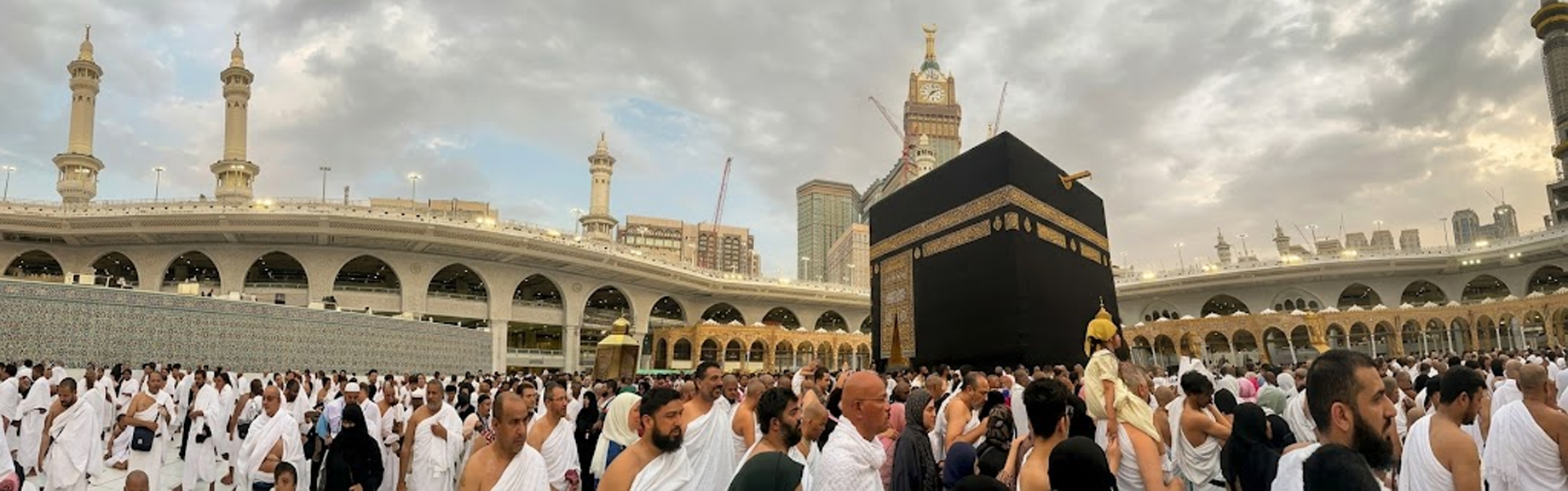
Umrah is a voluntary Islamic pilgrimage to Makkah, performed by Muslims at any time of year. It consists of four acts: entering Ihram, performing Tawaf around the Kaaba, completing Sa’i between Safa and Marwa, and cutting or shaving the hair. Unlike Hajj, Umrah is not obligatory, but it carries immense spiritual reward and is accessible to Muslims worldwide.
More than 3.45 million Muslims live across the United States (Pew Research Center, 2017). For you, as for millions worldwide, Umrah may be one of the most profound journeys of your life: a voluntary act of worship that places you, for a few days or weeks, in the holiest city on earth.
For American Muslims, it is also a logistical undertaking. It spans 18 to 24 hours of travel, a US passport and visa process, and planning that looks very different from what pilgrims in neighbouring countries face.
This guide explains what Umrah is in full: its meaning in Islam, what the rituals involve, who can perform it, when to go, and what the journey actually looks like when you are leaving from New York, Houston, Chicago, or Los Angeles. Whether this is your first time or you are helping a family member make the trip, this is the complete picture.
Umrah is a voluntary visit to the Masjid al-Haram in Makkah, made with the intention of worship.
The word itself comes from Arabic and carries the sense of visiting a populated place. In Islamic jurisprudence, Umrah is a Sunnah Mu’akkadah, a strongly recommended act that the Prophet Muhammad (peace be upon him) performed and encouraged for every Muslim able to undertake it.
Umrah is not a once-in-a-lifetime obligation like Hajj. You may perform it as many times in your life as you are able, and many Muslims do. Scholars understand it as an act of purification and renewal: a chance to stand before Allah in Ihram, stripped of worldly markers, equal to every other pilgrim circling the same house.
Umrah is not a substitute for Hajj. It is a separate act of worship with its own completeness. Performing Umrah does not fulfil your obligation of Hajj; the two stand as distinct expressions of the same devotion.
Hajj is an obligatory pillar performed on fixed dates; Umrah is voluntary and can be done any time of year.
The two share sacred ground and several rituals, which is why they are so often confused. The distinction matters in practice, whether you are planning one or the other.
Hajj is one of the Five Pillars of Islam, obligatory once in a lifetime for every Muslim who is physically and financially able. It falls in the month of Dhul Hijjah, on fixed dates, and its rites extend beyond Makkah to Mina, Arafat, and Muzdalifah. According to official Saudi statistics, a total of 1,673,230 pilgrims performed Hajj in 1446 AH (2025).
Umrah is voluntary, can be performed at any time of year, and takes place entirely within Makkah. There is no quota, no fixed date, and no travel to sites outside the city. Its rituals, Ihram, Tawaf, Sa’i, and Taqsir, are also part of Hajj, which is why the two feel related. But Hajj adds rites that Umrah does not, and carries a different weight of obligation.
What this means for you as a US traveller: you can plan Umrah in any month, complete it in a trip as short as 7 days, and book it through an operator without the quota restrictions that make Hajj so competitive, and for many a years-long wait.
Umrah is four acts in order: enter Ihram, perform Tawaf, complete Sa’i, then cut or shave your hair.
Ihram is both a state of mind and a physical act. Before you reach Makkah, you enter Ihram, a state of spiritual consecration, at a boundary point called the Miqat. If you are flying into Jeddah, this usually happens on the plane before landing, or at the designated points near the airport.
Entering Ihram means making the intention, performing Ghusl (a ritual washing), and putting on the Ihram garments: two unstitched white cloths for men, and modest, loose-fitting clothing for women. Once you are in Ihram, certain things become prohibited, among them cutting hair or nails, using scented products, and sexual relations. The state ends after the final act of Taqsir or Halq.
Tawaf is seven counter-clockwise circuits around the Kaaba, the cube-shaped structure at the centre of Masjid al-Haram that Muslims everywhere face in prayer. Each circuit begins and ends at the Black Stone (Hajar al-Aswad) in the corner of the Kaaba, and you recite prayers and supplications throughout.
You perform Tawaf on the marble floor that surrounds the Kaaba on every level. In off-peak periods the circuit is calm and takes around 30 to 45 minutes. In the final nights of Ramadan, the same seven circuits can take several hours because of the crowd.
After Tawaf you perform Sa’i: seven trips between Safa and Marwa, walking from one to the other and back, finishing the seventh leg at Marwa. The ritual commemorates Hajar (Hagar), the wife of Prophet Ibrahim, who ran between the two hills searching for water for her infant son Ismail. The covered walkway that connects them, called the Mas’a, runs alongside Masjid al-Haram and is fully enclosed.
The final act is cutting or shaving your hair. As a man, you can choose Halq, shaving the head completely, or Taqsir, trimming a portion from all parts of the head. As a woman, you perform only Taqsir, cutting a small amount from your hair. This act marks your exit from Ihram and completes the Umrah.
Any Muslim who is physically and financially able can perform Umrah, with some visa rules around age and a mahram for women.
There is no age restriction. Children and elderly Muslims perform Umrah, with arrangements made for accessibility as needed, and Masjid al-Haram provides wheelchair access and designated paths if you cannot complete the rituals on foot.
If you are a woman, the traditional scholarly position requires a mahram, a male guardian who is a close relative, to travel with you. In recent years, Saudi authorities have adjusted the rules to let women aged 45 and above travel in organised groups without a mahram. Under 45, you will typically still need a mahram or a place in an official group package. These rules have changed before, so confirm the current requirement before you book (as of June 2026).
As a US passport holder, you are fully eligible to apply for an Umrah visa. There is no restriction based on nationality for Muslims who wish to perform the pilgrimage.
Any time of year. Ramadan is the most rewarding and most crowded; the quiet months are easier and cheaper.
You can perform Umrah at any point in the Islamic calendar, which is one of its key differences from Hajj. The most spiritually significant time is Ramadan: many scholars cite the reward of Umrah in Ramadan as equal to performing Hajj, based on a hadith of the Prophet (peace be upon him). That also makes it the most crowded and most expensive period.
If you are travelling from the US, the easiest months logistically are the quieter ones: Muharram, Safar, Rabi al-Awwal, and Rabi al-Thani. Crowds are lighter, costs are lower, and you can move through the rituals with more focus. The shoulder periods around Rajab and Sha’ban balance a strong spiritual atmosphere with manageable crowds.
School holidays and the summer months (July and August) draw more US families, since it is easier to travel when children are out of school. Those months work, but book earlier.
A longer trip than most: 18 to 24 hours of travel each way, a visa through a licensed operator, and usually 7 to 14 days on the ground.
For American Muslims, Umrah is a bigger undertaking than it is for pilgrims from neighbouring countries. Planning for it as such makes the whole experience better.
Flights from US cities to Jeddah or Madinah usually involve one or two connections through hubs like Istanbul, Dubai, Doha, or Cairo. Total travel time from most US cities runs 18 to 24 hours each way. A realistic trip therefore spans 7 to 14 days on the ground, and 10 days is the most common choice for a first Umrah.
As a US citizen, you apply for your Umrah visa through a licensed travel operator; you cannot get it independently. A full trip, including flights, accommodation, and visa, typically runs from $2,500 to $6,000 or more per person, depending on the season, the length of your stay, and the tier you choose.
For a full breakdown of each part of planning, see the related guides:
How long does Umrah take from the US
Umrah visa from the USA, step-by-step
How much does Umrah cost from the USA
Umrah requirements and what to pack
Muslims who have made Umrah often describe the same shift: standing before the Kaaba for the first time turns the abstract into something concrete. The direction you face in prayer five times a day, from New York, from Houston, from wherever you are, suddenly has a physical reality, and Umrah is the act of travelling to it.
The preparation, the distance, the ritual: all of it is part of what makes the experience what it is. Umrah is not difficult to understand. It is difficult, in the best sense, to put into words.


